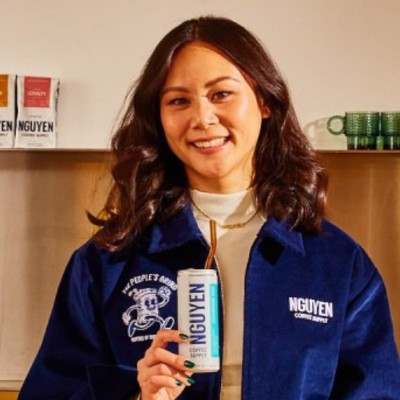
[00:00:05] Melissa Traverse: Hello, and thank you for joining. I am Melissa Traverse, Director of Community here at BevNET CPG Media, and I am excited to welcome you to the Nombase podcast, a podcast built to help CPG owners and operators navigate growth challenges and grow more profitable businesses. Be sure to check out Nombase.com, BevNET's platform for the CPG community, where you can find tactical content like this and so much more. Sahra Nguyen started Nguyen Coffee Supply in Brooklyn in 2018 with a mission to bring Vietnamese coffee and the robusta bean to the American market. She spent years building a community online before taking her ready-to-drink line into national retail. She's still scaling, still figuring out parts of it in real time, and has picked up a lot of hard-won knowledge along the way. Fane He started Lucky Ox modern Asian craft soda brand with bold, authentic flavors last year as a co-founder. Lucky Ox has been delivering cases by subway, driving to Whole Foods Market grand openings just to get in front of buyers, demoing like crazy and figuring out their product, their category, their place in the market, all at the same time. They got into Whole Foods across the Northeast in under a year, and now they're trying to figure out how to move product in stores they can't get to. They're trying to figure out how fast to scale and what it actually takes to build a brand that translates beyond New York. Sarah has been a mentor to them since before they launched. And today they're going to dig into all of this together. So, you know, if you out there building a brand right now, you're probably going to hear yourself in this conversation. Sarah and Fain, so great to have you here at the Non-Based Podcast. Thank you for joining us today. Sarah, you've been building Nguyen Coffee Supplies since 2018. Please tell us a little bit about yourself, where the brand started, where it is now, and what the mission behind it has always been.
[00:02:08] Sahra Nguyen: So I was born and raised in Boston, Massachusetts, so shout out to BedNet HQ. And both of my parents are from Vietnam, and they are actually refugees, and they escaped to Vietnam shortly after the war ended. And so growing up, I had a lot of exposure to Vietnamese food, coffee, and culture, because they would bring me back to Vietnam throughout my entire childhood and life to visit my family abroad. And so I've always known that Vietnamese coffee was really, really unique and different and special from the coffee that I would see in, Boston in the United States, right? And so around 2016, when I was visiting a lot of different specialty coffee shops, I noticed that Vietnamese iced coffee was becoming really trendy. However, I couldn't find a single origin, fresh roasted Vietnamese coffee bean anywhere in the specialty coffee scene. And so that set me on a whole journey to go back to Vietnam in 2016 and conduct my very first sourcing trips. And from that trip, we established our first direct trade relationship, whom we still work with today. His name is Antien. And then in 2018 was when we first started to import our own green beans and roast them fresh in Brooklyn, New York. When we first started, we were entirely direct-to-consumer. We really built the brand online and through social media for the first couple of years. And then a couple of years in, we launched nationwide with Whole Foods Market, and now we have an entire retail channel for our business. And today, we're still building with our coffee beans. We also have a ready-to-drink coffee line. And then we just recently launched our brown espresso canister.
[00:03:37] Melissa Traverse: And you really changed the way that Americans think about the robusta bean.
[00:03:42] Sahra Nguyen: Yeah, oh my gosh, that's right. Because the thing that makes Vietnamese coffee really unique and different is the coffee species itself. So Vietnam is not only the second largest coffee producer in the world, they're also the number one producer of robusta beans. And prior to all of this, specialty coffee culture in the United States is really centered around the arabica bean. And so robusta and arabica are basically like cousins in the coffee world. And so they're very different in body, in flavor profile, and also in caffeine levels and energy.
[00:04:12] Melissa Traverse: Fane, we are so thrilled to have you here with The Lucky Ox. Please tell us a little bit about yourself and about The Lucky Ox, what you're making, who it's for, and where you are in the journey right now.
[00:04:23] Kyle Nguyen: Kyle and I started The Lucky Ox last year in 2025. I grew up in my mom's Chinese restaurant. I was that kid doing homework in the back of the restaurant and helping out in the kitchen where I could. And that's really where I developed my love for cooking and just being super adventurous with different types of cuisine. to experiment with, you know, my mom was always cooking up new things, bringing stuff from different restaurants for me to try. And, you know, I always wanted to open up my own restaurant. And I met Kyle at her first job out of college in consulting, and, you know, we were pretty set on, like, trying to open up a restaurant. We always cooked together, and that's how you knew that we would work well together is because we just meshed so well in the kitchen together. you know eventually we just saw like just the day-to-day grind of doing the same thing operating a restaurant and uh but we still wanted to do something to push the Asian flavors we grew up with forward and you know we didn't have any focus groups or anything but we just launched the Vietnamese salted lemonade like just a very hole-in-the-wall recipe that you can really only find in a grandma's kitchen and because we're in beverage it's definitely a harder category to like build a d2c presence in so Me living in New York, I was just going door to door to every bodega, restaurant, cafe around town. And, uh, you know, shortly after Kyle and I built up to like our first hundred accounts, we didn't really know what we were doing. We had glass bottles and, um, glass bottles would break in transit. So we'd have to deliver things on the subway. Then we finally, you know, got some distributors and then, uh, we recently launched into a whole foods market. And then, yeah, we're in over a thousand doors along the, East and West Coast and like slowly building our way in Middle America as well. But, you know, now we have five SKUs with really authentic flavors, like pandan coconut first to push pandan in a beverage form to the market. And then our two new SKUs, we put Taiwanese pineapple cake and mango sticky rice into craft sodas.
[00:06:13] Melissa Traverse: You know, something I think that both of you have in common is that you have beverages that are authentic to the culture that they come from. They're also delicious. You know, they're very appealing to people who may not know anything about where they come from or the origins of the ingredients. Kyle, you know, you and I have actually been talking about doing a show for a while. And, you know, I think one of the questions you've been asking for a while is how fast to grow. You know, you've built a really strong business in New York City and now you're seeing opportunities to grow a little bit wider, maybe a little bit faster, but you know, you've been trying to figure out what the right pace is. I'm going to hand the mic over to you. I know that this is a question that you probably already talked to Sarah a little bit about, but I would love to hear your questions and what Sarah has to say about them.
[00:07:10] Kyle Nguyen: definitely as a niche Asian beverage brand. Some people know about our flavors and most people in the country don't. So I guess, Sarah, you know, I'm curious as you've built your brand, how did you know, how were you able to build enough of a presence around the country to know, all right, here's, when can I expand? beyond New York City, beyond coastal areas with higher Asian populations? And do you really think that the direct-to-consumer presence that you built through your bean business really helped to sort of inform that there was a demand?
[00:07:41] Sahra Nguyen: Well, I liked it at the time. I knew using the data from our CDC business, but then now being a couple of years into retail, it's kind of like, you don't really know until you do it, you know? So, you know, we launched, you know, the CDC business, which was primarily coffee beans in 2018. And then we went nationwide retail in 2023. So. we really spent a solid four years building the brand awareness and equity through DTC and through social media. And so we had like, so when we would enter retail conversations, we'd have all these heat maps around like, here are our top regions and states based on our DTC audience. And when we launch, we're gonna geotag all of like the ads and the retail ads, the coupons, et cetera. And so I do feel like we had a very informed approach to the best that we could when we're entering retail. And I think to some extent, a lot of that does help and it is true. However, what I've learned is not only from the channel of DVC to retail, but also the product lines of beans to RTDs. There's still just so much that you don't know until you go through it, right? And so I'd say, particularly with the products of like the beans, which informed DTC, which informed our retail strategy, which really about the RTDs, it wasn't, it was like slightly transferable. Cause it was like, well, these are the folks who like Vietnamese coffee, who are culturally curious, but they're also very different consumers, right? The person buying the whole beans and grinding at home is very different from the person grabbing the grater and coffee, right? So while I think that it's important to use that information to inform where you go, at the end of the day, there's still so much work and education that we still need to do once we do get to the shelf, right? And so that's how we approach retail expansion. But at the end of the day, I really didn't think we just have to go through it.
[00:09:30] Kyle Nguyen: What were some of those tough lessons that you learned, maybe more so specifically in markets where no one knows what Vietnamese coffee is? How are you going to convince people to buy your product off the shelf?
[00:09:42] Sahra Nguyen: when we launched, we did launch nationwide, like all 50 states, right, with our RTDs, which is kind of, it kind of goes against, like, conventional wisdom of, like, go deep before you go wide, right, which I really still support in a lot of ways, but for us, just given our situation, we just had a really unique opportunity to go really wide, and there's so many things on the back end that we were considering, for why would we go wide, something as simple as getting enough scale, so we can increase our MOQs, so we can increase our efficiencies, right? Like that was a factor in going wide. And then also, you know, going wide so that we can also grow at a certain rate. So we can also fund that growth maybe more quickly, maybe by attracting investors, right? However, I think, aside from like the, I guess, adjacent benefits of going wide really quickly, In order to win when you're going that wide, I don't really know if it's like, unless you're extremely capitalized, it's really gonna be hard to win in all those markets when you do launch going wide, right? So for us... Our top markets based on our DTC channel generally were the same as our top markets when it came to our retail and RTD business, right? And in the beginning, like we would try everything. We had a very multi-channel marketing approach where we had the TPRs, we had the secondaries, we had the digital meta ads that were geotagged to our store list within like one to two mile radius. We ran like digital coupon ads. We ran ads with digital coupons to drive people in store. We had out of home, right? And I think after doing all of those different experimentations, I would say. If you have a lot of money, run them all. And I'm sure you could find some attribution model that creates like an argument for all these different halo effects have helping each other. But I'd say if you are maybe a little bit more limited in your resources, I always believe in invest as close to the point of sale as you can. Like if you had to put your dollars somewhere, put it as close to the point of sale as you can. And so that can be as simple as a yellow tag, a TPR. Right. And yes, I think let's say, you know, whether it's in a. popular region or maybe in a region where there's less awareness or presence or brand presence. Sure. A TPR won't really drive like the, the education that we may want that like a demo could, which is very expensive. But I I'd say like in a lot of places, like the TPR, like psychologically is very effective. It will get someone to kind of like stop at the shop and maybe take a peek in a way that maybe like improved packaging won't. Can't always do alone yet. So those are some, some of the learnings we had immediately. What about you, Fane? I mean, so you went from like, I mean, you guys, like, first of all, winning the introduction, I can't believe you launched last year, because you guys have done so much in such a short amount of time. So congrats again, it feels like you've been going at this for like at least two years. So you started like with New York, really regionally, then you went, you know, to both coasts now, like, what have you found to be effective or challenging?
[00:12:36] Kyle Nguyen: I think the first thing that I would just like to acknowledge is the reason why we were able to sell so quickly is because brands like you, Sanzo, Flybygine, have paved the way and proven the demand for Asian products that can be sold to a mainstream market at a premium price point. I think that has really helped, and I think also with k-pop culture and everything like asian products and culture is just really hot in the media right now and i think those were all tailwinds that really helped us to grow so quickly um but going back to your question sarah i think uh yeah starting off in the you know we're scrappy founders we had no experience in cpg so we just kind of thought all right we have to show up to every single thing we didn't have any sales people or distributors at the time so it was just door-to-door sales during the weekdays, collecting invoices, checking back in with the accounts a couple weeks later, and then doing the demos for those accounts every single week. And we just found that that is not scalable long-term. We are in over 1,000 doors now, and we can't show up to every single door. We're going to be continuing to expand to states that we're never going to be in. Um, but yeah, I think, you know, to your point, TPR has been really effective. Um, we've seen our whole food velocity increased by about 40% through TPR, you know, some of those stores in Connecticut and Jersey that we, you know, won't probably won't step foot in because, uh, tough to access without a car. I think it's that. And then now we're really trying to dive deeper into ads, um, geo targeting, you know, how do we build a brand digitally as well to just build that awareness and get people to come go to the store to try the product.
[00:14:17] Melissa Traverse: Sarah, I would love to hear you talk a little bit more about geotargeting. Does it work and how have you found it to work?
[00:14:25] Sahra Nguyen: the topic of like geotags are running like say meta Google ads that are geotagged to a particular region where you have stores and then you can send them to a landing page where there's a digital coupon. So they can then use that digital coupon and redeem it in store. Usually it's like buy one, like it's an offer where you get reimbursed, right? So that's a really long journey. Right. It's a long journey for one, someone to click through to get on your landing page. And it's a journey for them to actually remember the coupon and then go into the store or be in the store in the room to activate the coupon and then a journey for them to upload the receipt. Right. So does it work? Yeah. I'd say that you, I'd say that you could throw enough money at anything and make it work. Right. Like meeting, you can get people to show up in the store and you get them to trial your product and, um, maybe even post about it, but like, does it work? Profitably or sustainably it is a strategy of like if you're running a campaign to be break even or profitable say on the first purchase, I do think that the limitation for a lot of earlier brands where our economics are not as strong, but if you are running a strategy where it's like well willing to lose X amount of central dollars in the first purchase and just assume that we'll get paid back in six months or nine months because of the recurring rate, there should be ways to cut the strategy. And I'd say there's no right or wrong. The strategy is very much tethered to how capitalized you are.
[00:15:49] Kyle Nguyen: For us as a smaller brand that isn't heavily capitalized, where we can't be running those expensive coupon programs and super expensive ads, I'm curious. for these people that aren't aware of, you know, your products or just any Asian products and, you know, some of those harder to reach states, what sort of the messaging, I guess, you know, if you're just going to do a general ad, you know, just to build awareness and education, what is it? What is the messaging that you think has really stuck to trying to convert people to to try the product out?
[00:16:23] Sahra Nguyen: Mm-hmm. Yeah, that's such a great question. So one of the things that we were asking ourselves in the beginning was more like, what really speaks to people? Is it the robusta bean narrative, the differentiation, the core ingredient, which is so much of our mission to elevate that coffee species, right? Or is it Vietnamese coffee, right? And so the way we explore this was a lot of like, One, just exploring Google Search Console and seeing what people what are people searching, and also like running ads or tests with the copy of robust diversity is coffee and seeing what the click through rate is right so seeing what engages clicks on an ad. We found out like this, like different parts of the funnel and like, or like different consumers, right. There are consumers who really care a lot about mission and sustainability, and they care about the women owned aspect. They care about the mission, like this, this like mission of like, wow, we're the underdogs and we're like changing this whole, you know, industry through Champion Robusta. And there are the consumers who maybe like, don't make a purchasing decision strictly on that. Maybe they came up with a function, like how is this coffee can or bean going to enhance my coffee experience. So then for those consumers, we can lean more into functionality, like robusta beans have double the caffeine content of arabica. It's a great source of natural energy. It also has 60% less natural fats and sugars. So the flavor profile is very bold and low acidic, right? So we just, you know, I think a lot of these learnings did come from running meta ads for our DTC channel, right? It's not transferable to how retailers shop, but it does give us a little bit insight into like how our coffee consumers shop, right, when it comes to cans and beans. And another great thing that we did, which I love to share is one time we exported all of our customer reviews on a website. And we basically did a keyword analysis to see what keywords are people using to describe our product the most. Like what's resonating with them. And because what I think is important may not be what's important to the consumer and how they're, what's driving their purchasing decision. So then we would just kind of use a lot of that back in our own marketing and our ads, right? Yeah.
[00:18:28] Melissa Traverse: I'm so curious, what words did you find resonated?
[00:18:31] Sahra Nguyen: Number one, smooth came up with like a very popular smooth, bold, strong. Yeah.
[00:18:42] Kyle Nguyen: Definitely seen that in your guys' packaging.
[00:18:45] Sahra Nguyen: Yeah, it was flavor for sure. Yeah, actually, I don't know how to rank it between because we toggle between flavor and energy a lot because it's very different from Arabica. Flavor ranked a little bit higher than energy.
[00:18:56] Melissa Traverse: So I know we were talking about this a little bit when we were preparing for the call, but I know you're already thinking a little bit about the center of the country, middle America, and how to penetrate that. I'm curious, Sarah, you launched nationally. What are your thoughts on how to enter the middle of the country? Are there certain regions that you found were more receptive to the product and the value proposition? How would you go about that as someone who's already launched in all states?
[00:19:26] Sahra Nguyen: So we're across the country with Whole Foods, we also have like a Midwest broker that's really specialized on those retailer relationships. And so for us, it was interesting because we never like intentionally, we never were like, okay, now we're ready for the Midwest. It happened with Whole Foods. And then at that point, it became a strategy of like, well, we have these DCs open. Now, we need to optimize these DCs that are located in the Midwest servicing the Whole Foods business. And so from there, we layered on a Midwest broker to basically selling to accounts that are pulling out of those DCs, right? So it was, it was actually, I guess, less of like a brand mission strategy, more of like a, I guess, ops optimizing RDC strategy, which ultimately helps for sustainability efficiency as well. And then, so that's how we landed, kind of landed in the Midwest. And now when it comes to like, how much do we invest in this market? So at this point in time, you know, we're still the strongest on the coast naturally. And so when it comes to Midwest, like, you know, we don't have a field team out there. We don't have. ambassadors out there. So a lot of our attention really has really been driven through TPRs, right? So candidly at this point, we haven't really heavily invested in the Midwest. It's more of like, what can we do to keep like the average within those regions healthy, right? So maybe that means not investing in every store that's pulling out of that DC. but figuring out like what is like the benchmark for units that need to be moved out of that DC, which is different from the velocity benchmarks from your retail or like a Whole Foods. And then figuring out like, you know, as long as that DC is generally healthy, right, which will maintain that DC would be open, figure out like what are the top maybe five, 10, 15 accounts that will just bring your average up for that region to kind of keep that DC open, if that makes sense. So I guess it's like, yeah, not focusing on every store because we don't have the capacity and resources to focus on every store, but focusing on the right ones to keep the retailer life supportive and also the DC happy as well.
[00:21:33] Melissa Traverse: And are there any regions that are more receptive to, you know, more interesting products than others? Like, is the Chicago area, you know, a better mover than, you know, maybe other places?
[00:21:47] Sahra Nguyen: Yeah, we definitely see Chicago being kind of like a very popular destination to be really responsive. There's also actually surprising a lot of Vietnamese coffee shops in the Chicago area as well. So there's actually a lot of awareness around the category there.
[00:22:02] Kyle Nguyen: Yeah, and I think that's just for any more flavor-driven Asian brand, you know, when it's a big urban area with a lot of higher-end modern restaurants and bars and cafes, I think, honestly, we all kind of, it's kind of a flywheel effect where, you know, they, people try those flavors, they're lining up for restaurants like soother right michelin-nominated or um starred uh asian restaurants they try those flavors in the restaurant and then they find us on the grocery store shelf or other way around and you know i think we really work in tandem and that's why we really value our on-premise partners as well i'm curious you know sarah as you scaled the rtd business and also just the bean business in retail you know um do you think that there given that there just aren't that many Vietnamese coffees on shelf currently there once was you know a big competitor at the time like do you think that having some additional uh competition on on like a shelf like at Whole Foods helps to just drive overall awareness for that category versus stores you know where you are the only Vietnamese coffee offering?
[00:23:11] Sahra Nguyen: I definitely believe in the vision of a rising tide lifts all boats, especially when it comes to a more nascent category like Vietnamese coffee, within a larger category like coffee. I like to draw a parallel often between matcha and boba subcategories within a larger category. So given this very unique point in time in our journey and in like the country's cultural expansion of coffee and global flavors, the more brands there are, the more Vietnamese coffee brands there are, like Educating and Marketing and Tama Vietnamese Coffee and increasing impression on the internet and, you know, raising awareness, it's just going to help all of us, honestly, right? And so, and honestly, I think like, when we get to the point where a retail buyer is willing to have two different Vimis coffee brands, RTDs on shelf, like I think that's a huge win, right? Because right now, oftentimes, given where we're at in the category, and it's still growing, a lot of the conversations have been more a little bit more of like, well, I can only have one Vimis coffee brand, because I already have one, right? And I'm sure at one point, matcha was very similar to that. And now we have so many matcha brands and matcha screws on shelf, right? So I would actually think would like for there to be more of these coffee brands on shelf, because that just shows that the category is growing, and the demand is growing, and like the reception across the board from buyers to consumers is also growing, right? Now, that's just like my belief in the category and my desire for the entire community of Vietnamese coffee growers to producers to brand builders to do well, right? Because we need to grow the pie together. And then at the end of the day, it comes down to winning on a shelf, right? Like everyone at the end of the day needs to win on a shelf. So to get on a shelf is great. More brands on a shelf is great. And if another brand, if I'm on a shelf with another brand and they beat me out, then like, you know what, good for them because they did something right, right? And if our brand wants to be on a shelf, then we need to continue being great, delivering value, listening to our customers, you know, innovating, pushing things forward. I don't believe in staying on a shelf because you're the only one. I really believe in staying strong because you are the best brand.
[00:25:21] Melissa Traverse: You know, I think the topic of category is a really important one. Sarah, I think you actually launched Nguyen Coffee as a cold brew, right? And you got told we already have five cold brews and then you pivoted to being a Vietnamese coffee. Can you talk about that a little bit and talk about how you figure out where your home is?
[00:25:43] Sahra Nguyen: We always were Viva's Coffee, but when we first launched our very first RTD, which was a black, this was the very first can actually, we really leaned into cold brew messaging. We put cold brew on the SOI, and we used cold brew coffee, which is in the ingredient statement, and it says Viva's Coffee up top still. And our thinking at the time was like, well, let's meet people where they're at. Cold brew is extremely popular. Consumers know what a cold brew is. So maybe that could be like our access point. And then our differentiation is Vietnamese coffee, right? And we even won a BevNET Bestie product for our 100% robust of cold brew in 2022, because at the time, no one was doing a robust of cold brew, right? And then, but like, so that was like the, the line of thinking behind it and um however as we were in the retailer conversations a lot of retail buyers are like we already have a ton of cold brews we don't need another cold brew and i was like oh my gosh like this is not working because i've been like we pretty much now this is like our new our new can our new packaging we pretty much stripped cold brew from the front of pack. I mean, it's not even in the SLI anymore. It's still in the ingredient statement because we still use cold brewed coffee. But now it's like the Vietnamese coffee is like so much bigger, right, from like this little tiny color here. The SOI has Vietnamese coffee in it to the cold brew. And so the learning there was really like Though I was trying to really meet consumers where they're at, again, like sometimes you just don't know until you go through it, right? All the data in the world can point you in a direction, but at the end of the day, you won't really know until you go through it. And then our biggest learning was just to continue leaning into our differentiation and leaning into, you know, how we can bring value, but also expand the category, expand the set, particularly for buyers. So that's been a huge learning for us.
[00:27:32] Melissa Traverse: How is the lucky ox navigating category confusion? How are you calling yourselves and what does the evolution look like?
[00:27:39] Kyle Nguyen: when we first launched we just because we kind of took a very restaurant approach to things we called ourselves a sparkler and that's a very abstract term i think to a consumer looking at the shelf right where you see tonic and soda seltzer um whatever non-alcohol around so sparkler is just such an abstract term that we thought was really cool at the time you know we're coming from nike we just like these like cool, trendy buzzwords. Then, you know, because we were just doing something so unique, we just, like, didn't really know. We didn't really want to call ourselves quite a soda because, you know, Olipop and Poppy were, like, really carving themselves into that category. So we're like, okay, maybe we're sparkling juice. We have, like, Vietnamese lemonade has, like, 20% juice content in it. So called herself sparkling juice for the longest time. And then we found that people, the non out crowd really loved us, the mocktail crowd and even the cocktail, you know, mixer crowd bars were using us as a mixer for, you know, for their drinks. And we kind of just were like in this sort of catch all bucket. And then it was really during, our launch with Rainforest when we did a ride along in the mid-Atlantic region that we just saw craft soda was just such a big category. And that's when we kind of just, you know, figured out our home. We're like, all right, you know what? We're not a functional soda. We still are a soda at the end of the day. We have a lot of versatile drinking moments between a meal pairing, a treat, and then also as a mixer. So, you know, sodas out there like Jones and Gus's and Reed's, right? Those are all drinks that have really versatile drinking moments. We're like, all right, let's just, Let's hone in on this. Let's just define this craft soda category. We're doing new exciting flavors and bringing that to that specific category that, you know, really is just more high sugar legacy brands with like the same, you know, flavors kind of generally all around.
[00:29:27] Melissa Traverse: I actually have a question for both of you. How do you deal with the difference between the way that consumers search for a beverage and the way that retailers are merchandising them?
[00:29:40] Kyle Nguyen: For us, you know, what's actually really interesting is Whole Foods is actually expanding us within their cocktail mixer set. And, you know, when we first heard that, we were super excited. We're like, OK, great. We can we have the opportunity to go really wide with Whole Foods. But at the same time, we're like, well, we're we're still a soda. You know, we're a single serve soda. We're not the same as a fever treat. But, you know, luckily, I think for that specific category within Whole Foods, it is actually kind of a bucket of, you know, there's some functional drinks in there. There's some non-alps. It's not just your fever trees and your Q-tonics. As far as the merchandising is concerned, you know, we're going to be there on the dry shelf, bringing some new excitement into that specific set. As a single bottle, it's easier to drive trial than buying a four-pack of whatever, ginger beers. But at the same time, we do thrive in the cooler, ultimately. A lot of stores have us next to their hot bars, maybe next to a sushi bar, where we're a great meal pairing because we're not an energy drink or a stevia sweetened functional drink. We're there to complement a meal or just to act as a sweet treat in the middle of the day.
[00:30:46] Sahra Nguyen: I mean, when it's cold, it's sold, right? That's the thing. We've definitely run into this pain point where, you know, for sure, anytime in the cold box, we perform better because it's a ready-to-drink product. Um, and that consumer behavior of like, let me walk to like the back of the store and into the dry shop and buy this one single can that's ready to drink, but it's warm. So I have to bring it home and put it in the fridge and then I'll drink it. Like that's just not really how our consumers that we found quite purchased. So we've launched both in the cold box and on the dry shelf. And we've just found that being on the dry shelf for us doesn't quite work at this time in our company. Now, I think if there was another company with a different strategy that was more capitalized, if they want to fund that growth just through more aggressive TPRs, maybe take a loss in the unit because they're really looking for growth in scale. And again, they can support a longer payback period. Sure, I think that could work for some brands, but for us, that's not the approach that we could afford to take. And so at this point in our journey, like if it's on the dry shelf, we actually turn it down. We've just found just by trial and error that it's really not worth it for us right now to be in the dry shelf because it's not sustainable for us. And we just also, we just don't feel like that's how consumers ultimately wanna enjoy a way to drink coffee.
[00:32:09] Melissa Traverse: Even if you find the perfect category for your brand, there are always merchandising mishaps. Fain, you were talking about you found the product in backstock in one store, it wasn't even on the shelf. I think there was another one where the product was shelved next to clam juice. Can you talk a little bit about the merchandising mishaps you've had and how you're trying to figure out your way out of that?
[00:32:34] Kyle Nguyen: Yeah, definitely. And I think that also just comes with just being such a unique cultural product, whereas people sometimes just don't know where to put us. You know, a grocery store chain might have a completely different set and like merchandising strategy than independents, which we have probably about seven, 800 of those. And each of those independents is going to function very differently. So yeah, there's your point, Melissa, you know, in some stores, we've been next to waters, other stores, we've been next to functional beverages, like, you know, the vitamin waters, and then the other ones were next to clam juice. And, you know, it's, we don't know that until we're actually going into the store, but we're not able to go to every store. So I think fractional support, merchandising support has really helped to just increase that visibility at the store level. Obviously, when we can, we're trying to go and demo as much as we can and say hi and shake hands to people in stores, thanking them for carrying our product and stuff. And I think that really goes a long way and helps to also developing that relationship definitely helps to get some better shelf space too to get out of clam juice set and onto the bus.
[00:33:47] Melissa Traverse: Sarah, do you have any other tips that you could provide on how to make sure that you're merchandised correctly in those stores that you just can't get to?
[00:34:00] Sahra Nguyen: Yeah. I mean, so we're talking about merchandising strategy. And then there's also just before the merchandising, there's just the execution. You mentioned inventory in the back room, Melissa. We've definitely struggled with that as well, where some of our product just wasn't ending up on the shelves. And when we look at our sales data, we're seeing inconsistency with our velocities. And so having merchandise go in to help, that's one thing. But then in the past, we've actually paid a team to do a store survey, to survey 200 of our stores just to see what's happening on shelves. That's a one-time effort. And then we found that actually over 50% of our stores were out of stock. Right. And so there's just like such a huge and it wasn't due to inventory issue. It's like execution. Right. You know, one thing to solve kind of like a huge out of stock, which is kind of like resetting or recalibrating our inventory is, you know, we've asked our buyers in the past. Once you've done this survey, we have the data. We have the stories that have the gaps. We deliver that to our buyers. Like here are some huge issues and holes.
[00:35:07] Melissa Traverse: And I think you mentioned that you actually paid a team to survey. It was like 500 stores or something like that. And you, when you found out that 50% of the stores, you didn't have the product on shelf, was the plus out the answer to that? How did, how did you fix the problem where, you know, almost half the stores didn't have the product? What did you do about that?
[00:35:27] Sahra Nguyen: Unfortunately, in that particular situation, a plus out was not the solution. It wasn't quite possible with that particular experience. And so the guidance in that situation was to literally have our folks go store by store and work at the store level to basically reset the inventory. So then the next step would have been getting people, contractors, et cetera, to visit each store again after doing the survey to reset the shelves. which is very expensive for emerging brands.
[00:36:03] Melissa Traverse: Sarah, Fain was talking about some of the options that you have at your disposal to fix merchandising issues like that. What solution did you use? Did you send your own people in there? Was it a fractional merchandising team?
[00:36:16] Sahra Nguyen: Yeah, it was a fraction of merchandising team where they can do store surveys as a service. And then after the store surveys, they can do like merchandising support, working with the store leaders to place an order for inventory.
[00:36:28] Melissa Traverse: And Fain, what do you do? Is that typically what you do when you realize that the product isn't on shelf? How do you solve that problem?
[00:36:34] Kyle Nguyen: Yeah, I mean, if we can't actually physically visit the store, which, you know, we would prefer ourselves. Yeah, then, you know, we're lucky to have third party merchandising teams who are, you know, out in the field every day to check up on some of those problem stores that we have. there also was another chain that our merchandising team doesn't touch. So, you know, at that point, I was like, all right, we got to call the store up and see, you know, talk to the grocery manager and then see if we're even on shelf. So I think that's kind of like last last resort is just giving them a call.
[00:37:08] Melissa Traverse: You have to be pretty resourceful to be the founder of a beverage brand. Fane, you know, one of the last topics that we were talking about as we were getting ready for this conversation is PR. And there are so many ways to approach PR, especially with social media influencers, you know, that kind of thing. How are you thinking about PR for the Lucky Ox? What are you investing in now? And what are you trying to figure out? Like, how are you thinking about it for the future? Like, how are you trying to figure out where to go next?
[00:37:43] Kyle Nguyen: Something that's definitely always been a really tough part of beverage is scaling in D2C. And that's honestly the next challenge that we're really trying to take on. So we're launching a small pilot run of cans specifically for D2C and online wholesale. Way easier to ship than our glass bottles. But to really drive that D2C business, we're going to start working with creators, um, affiliates, and then, you know, having, having like a affiliate plan, you know, just to help to drive some more awareness and product education for us, uh, really want to just test that out and then see if, you know, we can grow the numbers, um, on D to C and which will ultimately help to, uh, drive our retail velocity as well.
[00:38:29] Melissa Traverse: Sarah, if you could provide the lucky ox with any advice based on what you've seen and done before, what would you say?
[00:38:36] Sahra Nguyen: Yeah, before I answer the PR piece, I had a question for you, Fain. I'm curious about how did you guys think about unlocking D2C? Like, did you find that that's where your consumers are shopping?
[00:38:48] Kyle Nguyen: obviously with retail activations, right? It's definitely pretty slow, you know, just to get one big retailer to say yes, and then finally being on shelf, right? So we just saw it as a quicker way just to like be able to grow the top line. And also the brands like Gia, Little Saints, some of those non-ALC brands seem to be the strongest beverage brands on D2C. So we do appeal to that crowd a lot, you know, the people are trying to drink less, people that want to use, try out a new mixer. So that's what we're really trying to hone in on is just targeting that specific crowd. And also, you know, obviously the culturally adventurous foodie. who is combing through the web and looking at whatever TikTok videos of new trendy restaurants. Mango Sticky Rice, for example, is a super hot trending flavor right now at bakeries and cafes all across New York City. So, hey, why not? You know, rather than telling those people, oh, go to Whole Foods and buy our Mango Sticky Rice exclusive flavor, why not try to buy a case through TikTok Shop? Because they're already posting on TikTok. That's kind of our rationale there.
[00:39:55] Sahra Nguyen: Yeah, the new cans look great, by the way. Yeah, I love them. For us as a brand, we heavily leverage PR as a marketing tool for our strategy. And so I get asked this question all the time. And so I always say PR is a really powerful tool, but you have to be really clear as to why you're using it. Like PR alone may not move the needle on your sales. um it's particularly not in retail because I think the the the journey is just too far um and so the way about PR is like usually it's like you do PR to get a headline and then oftentimes you use that headline to get something else versus like PR being the end goal it's like a tool to get to an end goal so a lot of ways that we use PR is for us in our category in our journey because we use coffee is such a young category and the robusta bean is like, you know, a less popular coffee species. For us, we needed a lot of education around the category for us to really sell our products, right? And so the way for us to approach getting that mass education was through PR. And once we had a PR piece, we could leverage that PR in our own organic channels to kind of like get more like juice out of it. And then we also, we would use PR to validate our vision and our mission in retail buyer conversations. we can use PR in our convos with investors. So that's how we've thought about PR. It's really a tool to get to another piece of strategy. But PR alone, at least for us, doesn't always move the needle on sales.
[00:41:21] Melissa Traverse: And Sarah, I know that you've built your personal Brad Avery well in a way that enhances new women coffee supply. How important is that?
[00:41:33] Sahra Nguyen: No gosh, I wish it wasn't so important. Honestly, I think there's, there's just so much pressure these days for founders to be content creators, because social media is such a powerful tool and yes while I've done that with my own personal brand and when Cox supply is a very like founder forward brand. it just worked out for us but also because like our brand is very rooted in my heritage, in my family story, in my culture, it's felt like a natural progression I guess of us marketing the brand. I wouldn't say that it's necessary for everyone. I don't want to believe it's a requirement for everybody because it is very demanding and taxing and I want to believe there are many other ways you can market a brand without leveraging the founder. So in terms of like throwing that guidance out there because I know how taxing it can be on the founder. I don't want to sit here and say like, you must do it. If it just doesn't resonate with you as a founder and it's like really painful, it creates more friction in your way of being. I don't know. I want to believe there's another way to mark your brand successfully as well.
[00:42:36] Melissa Traverse: Bain, how are you and Kyle thinking about that? Is that something that you're leaning into? Do you want to lean into it?
[00:42:42] Kyle Nguyen: Yeah, I think what's interesting between Kyle and I is our dynamic, you know, when it comes to the marketing piece. I think I'm more so just making a fool of myself on social media, you know, whatever, some eating challenge or talking in Chinese. You know, Kyle can't speak in any Asian language. So, you know, he's not doing those like videos where he's making a fool of himself as much. But I think he is definitely doing, you know, a good job of sort of being the voice of our brand within the industry. Where, meanwhile, I'm more so the voice of the brand, like, to the consumer. So, you know, I think it's good having two founders to be able to have, like, different personalities to represent, you know, within the industry and then to consumers.
[00:43:29] Melissa Traverse: Well, I think that shows a great example of how there is variety in the way that you approach it. So if one approach doesn't feel comfortable for you, then maybe there's another angle that you can use as the founder. Okay. So the last topic that we are going to discuss today is innovation and flavor innovation. Faye and I know that the Lucky Ox now has five flavors and, um, new in coffee supply. Sarah, I know you've gone through multiple iterations and multiple SKUs.
[00:43:59] Kyle Nguyen: You know something that is really interesting since we've been developing our skews is. When we try just a little sample at a time, I don't think that really represents the full picture of how crushable is this drink? Can you finish the whole can and you want to have multiple servings throughout the entire week? So Sarah, I'm actually really curious for you, how did you think about the crushability of your drink? Because Vietnamese coffee is something that when you buy it at a cafe, it's very strong. It's rocket fuel. normally people probably aren't drinking like five or six a week. So how have you thought about, you know, increasing the drinking moment, the frequency for, for your products?
[00:44:42] Sahra Nguyen: Chuggability is like a key metric in all of our tastings as we're developing new formulas, new flavors, and also reformulations. Because you're absolutely right, Fane, where it's like a lot of products, samples that we'll develop, they taste great. I'm always talking with the team. It's not enough that it tastes great. It's like, is this chuggable? And would you have it more than once? Experience is so important for sales and velocity, etc. Right. So when we first started our very first skew was a 100% robust a cold brew skew, it was called classic black. And then we came out with condensed milk and coconut right after that. So condensed milk was a very traditional one and then coconut is a non dairy one with coconut milk. We've since iterated the names of the SKUs from Classic Black to Espresso Black. Because Classic Black, we found, you know, people are like, I already have my classic version. I don't need to change it. I know my go-to classic for cold brew. And then we felt like Classic Black didn't lean into the power of Robusta, which is energy, right? So then after those learnings, we're like, well, people associate espresso with energy. So we actually reformulated the coffee to be a bit more of an espresso profile. And so maybe we need, we need that espresso black so it was just a little bit more and also conveyed energy. And then we've also iterated on the name of the skews from condensed milk used to say condensed milk. Now we've changed to condensed milk latte. So, people are like, is this a can of condensed milk, right. You know, sometimes it's like, you may think it's clear, because it says Vietnamese coffee condensed milk, but it's not. Like, I feel like you can never be too clear, especially when you're going really wide with your distribution. So now it says condensed milk latte, so that conveys a coffee and milk drink. It also, we decided to also align the name of our SKUs with how people generally order in a coffee shop, right? So it's always a latte. And then we also changed our coconut drink to coconut latte, right? So now all of our SKU names, Earlier this year, we released a cinnamon coconut latte. So they generally all not have latte to kind of align with how people order in the coffee shop. And then our latest SKU is the cinnamon coconut SKU. And the way we came upon that was one, our coconut SKU is our non-dairy option. And it was doing really well. And also when we looked at the non-dairy space, there weren't really a lot of coconut milk options. It's still very much dominated by like oat milks and I don't know, maybe almond milk. So we wanted to build upon that by adding cinnamon coconut latte, which we also saw to be a really popular flavor profile in the coffee space, you know, horchatas have that. It's also really popular in the category. So that's how we think about flavor innovation. However, I think there is this tension for a lot of like, really culturally rooted brands of like, how do we balance innovation and what's like super deeply authentic to us with what is approachable, what's accessible? Is it too watered down? Is it too far out? So like, man, I love to hear from you like mango sticky rice. I was like, wow, that's a that's a bold one. How did you come across that? Do you ever feel like it's just too innovative? It's just too out there? Like now that you are expanding coast to coast? Well, yeah. How do you think about that?
[00:47:59] Kyle Nguyen: you know, with some of the safer flavors, right? We're talking yuzu, lychee and stuff. Those flavors are very common now, not just to Asian brands, right? There's some more conventional energy drink brands that are actually using those flavor profiles. So I think, you know, our play has really just been to innovate, bring a new version of something familiar, right? You'll see two SKUs have lemonade in them. One has coconut, the other has pineapple and mango, but let's add the Lucky Ox spin to it. So with Mango Sticky Rice specifically, you know, Our first three SKUs, Matcha, Vietnamese Lemonade, and Pandan Coconut, got us into all these retail authorizations, but we wanted to know how we were really going to move off the shelves. I think what we've saw is people really like fruity flavors, so we wanted to do two, you know, more fruity flavors, and that's how we came with the pineapple and the mango. Specifically with mango sticky rice and Taiwanese pineapple cake, we didn't want to call them that. Originally, we were thinking of literally just saying Taiwanese pineapple cake sparkler, but, you know, one of our sales guys was actually saying that cake just doesn't sound very good for natural channel. Like, it just sounds, it doesn't really fit in for that type of consumer. And same with like sticky rice might just cause a lot of confusion for people in a drink. So we're like going back to our, you know, the chef-driven approach of things. Rather than calling it pineapple cake, we're calling it Taiwanese roasted pineapple, you know, highlighting the flavor profile. And then with mango sticky rice, we call it mango toasted rice. See how it just sounds a little bit better than sticky rice, which might throw people off about like the viscosity of the actual drink itself. So yeah, that's how we really thought about it. And I think, you know, all of our drinks really aren't just like single dimension, sweet, fruity drinks. It really has a lot of layer and depth to them. And I think that's exactly why people like our drinks, you know, not only as meal pairings, but also as mixers and mocktail alternatives.
[00:49:57] Melissa Traverse: Well, all this talk about flavor innovation is making me very thirsty. So I just want to thank the both of you so much for this conversation. Fain, thank you so much for, you know, the idea to have an open discussion about building a beverage brand. And Sarah, thank you so much for joining and contributing such great learnings and such great advice. I really appreciate both of you joining the Non-Based Podcast. Sahra Nguyen of Nguyen Coffee Supply and Thane He of The Lucky Ox. Thank you so much for joining the Non-Based Podcast. For everybody else, thank you for joining and we will see you next time. That concludes another episode of the Nombase podcast. If you enjoyed the show, please leave us a review and follow us on your listening platform of choice. You can also watch and listen to past episodes on Nombase.com. And don't forget to join our Nombase Slack at slack.BevNET.com for company updates, industry networking, and community discussions. See you next time.