Hey, everyone, Melissa here.
If you've been tuning in to the Community Call Podcast, good news.
It's still here, but with a fresh new name, the Nombase Podcast.
Why the change?
We just launched Nombase, a new digital community and directory built for the CPG world.
And this podcast is now an extension of that, bringing founders, operators, and experts together to share insights, tackle challenges, and help you grow in the industry.
You can still dive into all our past Community Call episodes, and of course, we'll keep bringing you insightful conversations with food and beverage founders, operators, and industry experts.
The name has changed, but the mission stays the same, helping you navigate the industry with real talk and real advice.
So if you're subscribed to Community Call, you're all set.
Just look for the Nombase Podcast in your feed.
And if you haven't subscribed yet on Apple, Spotify, or your platform of choice, it's the perfect time.
Now I'll let you get to the episode.
Hello, and thank you for joining me.
I am Melissa Travers, Director of Community here at BevNET and Notch, and I'm so excited to welcome you to the Nombase Podcast.
Be sure to check out nombase.com, the new platform powered by BevNET, where you'll find our partner directory, job board, press releases, and of course this very podcast, which brings us together today.
On today's Nombase Podcast, we are diving into the design process in part one of a two-part series with one of CPG's top design agencies and an emerging beverage brand undergoing a refresh.
We'll explore how design teams create winning packaging and branding, the brand agency collaboration, and the iterative process behind a packaging makeover.
If you are listening to this as a podcast, I highly urge you to check this out as a video so you can follow along with all of the great things we are seeing today.
Joining us is Paula Grant and her team, Melissa Piumbo and Jesse Quasar.
Paula is founder of Suite 9C, a design studio specializing in CPG packaging and branding.
With high-profile clients, you'll all recognize like BodyArmor, Lemon Perfect, and Core Hydration, just to name a few.
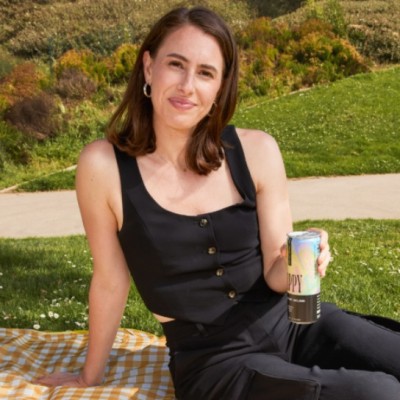
We are also joined by Maddie Frank, the founder of DAPI, a non-alcoholic functional beverage and finalist in the new beverage showdown.
It is a delicious beverage.
And as Maddie refines her brand's identity and better understands her consumers, she's seeking a packaging design that truly represents DAPI.
Together, we'll get inside the mind of an established agency, unpack the collaborative process, and take you through the key steps that turn a vision into a reality.
Paula, Melissa, Jessie, and Maddie, thank you so much for joining today.
We're so happy to be here and be part of the BevNET team.
Yes.
Thank you for having us.
This is a first for the Nombase Podcast.
I don't think we've ever really gone behind the scenes for a brand redesign and makeover and really see what it's like to take a brand's branding from one level to the next.
So I'm super excited about this.
Let's start off with a round of introductions.
Maddie, let's start with you and DAPI.
Please give us your brand story, how it started, where it is now and why it's time for a redesign.
Sure.
Yeah.
Hi.
So I'm Maddie Frank.
I'm the founder of DAPI Non-Alcoholic Drinks.
DAPI just launched about four months ago.
So it's very new.
The background is that I'm not a big drinker myself, big alcohol drinker myself.
And I noticed that whenever I wasn't drinking alcohol in social settings, especially when I first started cutting back in my mid-20s, I found there was such a stigma around not drinking alcohol.
It became totally normal for people to ask me why I wasn't drinking or even more personal questions about my health.
But when I was looking for non-alcoholic drinks to bring to parties and social events, I wouldn't just be standing there with a soda or a water.
I found most of the options were very health-focused in their branding or just felt a little more serious than the vibe that I was looking for and the occasion that I wanted to have the drink at.
DAPI is my solution to that white space in the market.
It's intended to make consumers feel fun and cool and chic and part of the party, whether they're nicking alcohol or not.
And DAPI rhymes with happy on purpose, right?
Exactly.
Yeah, so DAPI actually is short for adaptogens.
That's where the name came from.
But yes, I did consider that it does rhyme with happy and that just kind of goes along with the entire brand identity.
Well, I think alcohol or not, that's something everyone's looking for in their beverage.
And who did the design that you currently have?
Where did that come from?
It's a branding company in upstate New York called Key Branding Labs.
They were great to work with.
They were the first team that I actually worked with at all when I was working on DAPI.
And I think they got me to this point and it's been great.
But I think now that I've been in the market for a few months, I have a better understanding of the target consumer and the product market fit.
And now with that knowledge, I want to kind of design the packaging to better fit the learnings that I've had.
Well, so excited to get into this.
Let's do an intro with the team over at Suite 9C, Paula, Melissa and Jessie.
Again, so great to have you here.
Why don't you give us a little bit of a background on the studio?
Certainly, you have high-profile clients, notable designs.
Tell us a little bit about the studio, please.
I'd like to start off with, I love partnering with BevNET on everything.
You guys are one of the few places where you foster entrepreneurial spirit and really help people along.
And that's the reason that I'm working with Maddie in the first place, because you have people that have a lot of experience, me and myself and all of the people that you invite to these events, like Ken Sadowsky and Jess Quasar that was judging, and we're there to help younger, growing entrepreneurs get to the next place.
So this community is fantastic.
Thank you so much.
What we can bring to the table is what we've done at 9C, is we work from everything from Unilever, Pabridge Farm, like we've been in Body Works.
We've worked with these huge companies, but our sweet spot is actually working with entrepreneurs.
And myself, I've actually created products from white sheets of paper with nobody saying anything with Lance Collins, with Micropoly, you know, what does core look like, core water?
What is BodyArmor look like?
And had the opportunity and the amazing experience of like being able to see those brands, not only built, but seen through, gone on crew drives, gone to big geyser, sold in, you know, asked for money, did retailer meetings.
Jessie and I are sitting here together today because she was head of marketing, one of the heads of marketing for core water.
And we're working together to build big stories and see it through.
So we're a design firm and we're going to help Maddie redesign her brand.
But Maddie, what we're going to do for you also is like create a whole lifestyle around this beverage that you're creating because there is lifestyle attached to it and move it on.
The other thing that's interesting with all of this is just this particular beverage right now is an emerging space, right?
And whenever there's an emerging space, like non-alcoholic space, where does it sit?
How do you talk about it?
What is it called?
Where do you put it in the store?
What is it next to?
Who is your buyer?
That's a very interesting thing.
And that's emerging right now.
So I think for all of us, this is a very relevant conversation right now as far as like how do we talk about these drinks at all and how do we put them in your life?
I mean, when we think about does a packaging design like the ones that we find with BodyArmor, Core Hydration, you know, all of the brands that you've worked with, I almost take for granted that their design always was what it is.
And it's just so iconic.
How do you work with brands at an emerging phase to understand from a holistic perspective who they are and even who they want to be because at this stage it's it's kind of hard to know where you're going?
We had a brand recently come to us called Swoon and they had a they had a package that looked like this.
They're amazing female founders and they actually came to us through Big Geyser because they wanted to put their shrink racks, shrink wrapped sleeve on a can.
You can't have a design that's too fussy, be on a can because of certain things.
But as I was talking to them and they're like, my brand is this, my brand is that, my brand is that.
It was like a therapy session.
We're going to get into this a little bit later because the founder brings a lot to what the brand means.
This was not their brand.
This is kind of like dusty and like not cool.
So we transformed that into that, right?
And sales went up.
At least 20% to 30%, all things being equal.
Yeah, with no added marketing or support solely based on the new design.
So sometimes you just have to like listen.
And like I had to have a real conversation with them.
It's like, I hear what your brief is to me, but everything you're saying as an entrepreneur is not manifesting itself in this thing.
Like you want to be cool, you want to be hip, you want to be like tasteful, you want to be, I was like, we have to redesign it.
And so we just did it.
So I think working together, co-creating, that just happened recently for us also with Lemon Perfect.
That was a co-creation with Yanni.
He had a vision and we worked like this, like together.
It's really nice.
And Maddie, that's what we're going to end up doing with you as well.
Unfortunately, your first phase of work was like, oh, there's four designs, pick one.
That's not the way to actually do it.
It's, you know, talk, think, create, co-create, sit with us, let's get to a place where you're so happy and you're like going out there and you're like living the lifestyle.
Like that's how it should feel.
That's for every entrepreneur.
That's exactly how it should feel.
Well, I certainly heard the team at Suite 9C ask Maddie of DAPI some really great questions as we were getting ready for the show.
Maddie, one of those questions were brand inspiration.
What brands do you admire and why?
Could you tell us a little bit about those?
The four brands that I really like are Winey Baby Wine, which I think the name Winey Baby is just so cute, Dough Cookie Dough, D-E-U-X, Dirty Shirley Cocktails and Good Girl Snacks.
Kind of funny, both two of those out of the four alcoholic drinks.
But the reason I like them is because all of them have a really fun and playful style and they don't take themselves too seriously in their branding, which makes it really seem like there's like a personality behind the brand.
I also really like that they're all really cute and lean more into like a feminine style, which I don't think kind of targets just one gender, but I think I like the style being more feminine and then it can kind of be applicable to a wider audience.
I hear fun, playful, Paula and team.
Where do you take information like that as you're thinking about how to evolve the DAPI design?
What are some of the other questions that you had for Maddie that led you to some of the ideas that you have for her design evolution?
Yeah, I think we hear the brands that she suggests she likes, and if you look at those all, right away, you can tell it's a fun vibe.
She's looking for something that stands out a little on shelf and maybe doesn't play by the rules as far as category cues, which will take into account, do we want to play into the category cues?
Do we want to do something that goes against them for more standout?
When we first saw DAPI, we had a lot of questions as to how she made certain decisions.
We would ask, hey, that copy, the line of copy on the bottom is really fun.
Where did that come up with?
Where did you come up with that?
But also, if that's not working hard in that spot, can we use it elsewhere?
Can we bring the same personality?
Same as the background has a psychedelic pattern.
Where did you find that?
Why did you land on that?
And if we're going after that vibe, how can we play that elsewhere?
So we ask a lot of questions, but I think one of the most important things is we're getting to know Maddie on a personal level.
And Paula talked about that before, as far as the entrepreneur is so much a part of the brand that we really need to dig in and get to know her to get to know what her brand should stand for.
Right.
The other thing that's interesting, and this is for everyone, Maddie only developed two SKUs.
And when I've ever done, I've been in a lot of developing brands and asking for investment, right?
When you go out in the world, it's probably better to have at least three SKUs, and certainly a pipeline innovation.
One of DAPI SKUs is a jalapeno-based drink, right?
So that's like something that maybe consumers will say like, I don't want jalapeno, right?
So then you're only left with one.
If you have three, then there's a little bit more choice.
Sometimes there's not enough bandwidth on a shelf.
And also, as you're raising money, I think it's important to innovate even beyond three SKUs and go to the fourth, fifth, sixth, and say like, this is the company, this is the flavor profile, this is why we exist in the world, this is what I'm allowed to do, right?
In the terms of some of our other clients that we deal with, we've had to innovate entire shelf sets on multiple platforms between ice cream and granola and whatever, just to prove out a concept, right?
So it's okay in the beginning to say, what does DAPI mean?
What does that mean?
What brand is this?
Where can I take it?
That's how you start thinking about building a bigger brand and getting people to buy into it.
I'd like to go back to the original question, too, as to the initial intake with Maddie and the questions that we were asking that helped inform the work.
One of the most meaningful parts of this process is the fact that, first of all, Maddie, she has done this all herself.
She doesn't come from the beverage world, which is incredible, and she's bootstrapping this.
So, you know, the fact that she created this product and it's out in the market and she's selling it is incredible.
And what this sort of route to market has created is a really big opportunity for learning.
So Maddie's been hearing from retailers, she's been hearing from different channels even, whether it's on-premise or off-premise.
She's been hearing feedback on flavor, on design, on concept in general, what people like, what they're missing, what might change, whether it's, again, the formula itself or the name of a flavor or the depth of a flavor.
So, you know, it's a really natural and organic process.
And so we had a lot of questions about that too.
What are you hearing and how do you want to react to that?
Like, what can we do in the design that will help answer some of those questions that people have or position it better, you know, if originally you thought you were going to be fully on-premise, but you're finding that people in co-working spaces really like drinking your drink.
That actually changes the proposition quite a bit.
So rather than pigeonhole to one sort of channel or occasion, how can we make it work for both and be really relevant and still have that vibe and Maddie's feel and deliver on all of that?
So anything that the entrepreneur can share in terms of their learnings or insights and what we can help to solve for is also super important in the direction that they'll go.
Maddie, I think that's the perfect segue to hear from you.
What are some of those things that you shared with the team over at Suite 9C that you're hearing from customers about whether it's the flavors, about the packaging, where they're consuming the product?
What are some of those things that you've learned as your product has been out living in the world that's shaping the way this redesign is happening?
I started asking for feedback the week that I launched because I knew, as Jessie mentioned, I don't come from beverage or CPG at all.
So I knew I had a lot to learn.
So I've been collecting feedback since the week that I launched.
And from a taste perspective, I got a lot of feedback that the taste was really good, that people liked the flavors.
The flavors could be a little bit stronger.
So I think that's the big piece that I'm working on from the formulation piece.
From the packaging piece, there were two main pieces of feedback that I got.
First is that the hierarchy of information on the can, thank you, Paula, for holding it up, is a bit confusing.
And that's something that I, one of the many things that I've learned throughout this process, especially for drinks that are gonna be more sold in retail, which direct to consumer for beverages, shipping is very expensive.
So oftentimes retail is the best route.
And consumers have, I'm preaching to the choir on this, but something that I learned is that consumers have like three seconds, you have to convey what your drink is and why they should purchase it.
And the hierarchy of information on my can, it's just really hard to tell easily what it is.
It says, boost free functional drink, very small letters, kind of vertically on the can.
And then the flavors are all the way at the bottom, which I've noticed in the retail spaces that I'm in right now, or that DAPI's in, some of the shelves actually come up from the bottom.
So you can't actually see the flavors.
And then what the drink is, is in small writing.
So I think that's, that was a big piece of feedback that I received.
And then overall, the can design itself, like the artwork on the can, really leans more into being like just an alcohol alternative, which was what I was originally intending.
So it kind of met my original need.
But now after being in the market, like what, as Jessie was saying, like I've gotten more feedback from consumers about like where they're consuming it and when they're consuming it.
And I think it could be more of a broader drink than just only in like alcohol alternative settings.
And so I think that we can kind of make the design a little bit more broad in that perspective.
Tired of expensive agencies and freelancers who just don't get CPG or your brand?
Avoid headaches with Dark Roast.
Dark Roast specializes in day-to-day graphic design, including Amazon Creative, packaging, sales decks, and more.
Dark Roast is contract free, affordable, and nimble for your P&L.
Learn more at darkroast.co.
Paula and team, so you've certainly spent a good amount of time with Maddie and learned a little bit about her as a founder, learned a little bit about what consumers are saying and thinking about the beverage.
Is there any other research or idea aiding that you do in order to take you on the path of a redesign?
To reiterate that this is an emerging space.
This is actually a really interesting project.
There are more and more non-ELFs out there, and I do think there's going to be different segments of the store.
Is it a social tonic?
Is it an adaptogen?
Do people understand what the benefits are?
You'll see eventually through our work, how do you talk about any of this stuff?
Is it really going to affect me?
Is it going to make me feel a certain way or not?
What does it mean?
There's a lot of questions around this full little segment that's emerging, and we're going to have to deal with it in the beverage community, right?
Like we all have to like, it's just, where is it going to sit in the store?
How are we even dealing with this whole thing?
So there might actually be a little bit of a, we were talking about it, like we might have to do a little bit of testing of what certain words mean to people, what certain looks mean to people, and where it should sit.
I actually think we're going to win though by creating a lifestyle event out of this.
When we were at BevNET, a lot of people came up on the stage and they were talking about the golden hour and in your realm, Maddie, it'll be the DAPI hour.
How am I drinking it?
Where am I drinking it?
What is it for?
How is it going to make me feel?
We kind of have to wrap our heads around all of that.
And that's what we're trying to do right now.
Could you walk us through DAPI's current design and where you see opportunities for evolution based on what you've learned about Maddie as a founder, based on what you know about the product and the category, and also based on where we want to see DAPI in a year, two years, five years?
So we were showing DAPI at BevNET and asked our opinion, which always happens at BevNET, which is fantastic.
One of the initial things that I thought was, oh, she's using alcohol category cues.
The other thing we noticed on the back is it explains what DAPI genes do, but it talks about it calms you down, and it brings you up, and it was a little confusing.
We wanted to make sure that it's very clear that when you drink this, how you feel.
And then there's the functional pieces that could be optimized as well.
So to Maddie's point, with the flavor name being lower, can we move that up?
It's booze-free functional drink.
Booze-free again might limit the occasion based on what Maddie's learning to booze alternative as opposed to a functional drink occasion.
And then saying functional drink, what we were questioning, and again, what Maddie was hearing as well is, but what is the function?
It is on the side, but again, to the point, you have three seconds, you want to try to communicate that.
And right now, that's being communicated by this trippy design.
So is the function sort of a mind altering, a mild mind altering or what that is?
So all of these were opportunities to learn and sort of re-communicate and reconfigure in the consideration for the new design.
For all beverage people out there, whenever you put all relevant information on the bottom, don't do that.
It disappears.
I hope everyone's taking notes.
Beverage 101, don't put the information on the bottom.
But I mean, that's incredibly good information that if you don't come from this industry, you certainly wouldn't know.
I'm curious to hear what you guys think.