World’s Largest Coconut Water Range to Re-Enter US as Tariff Disruption Creates Market Gaps
Featured Listings
The news contained on this page has been provided by a third party. BevNET.com, Inc. does not verify, endorse, or vouch for any information or content submitted by third parties, or verify the identity, credentials, or expertise of third parties. We encourage you to consider carefully the source of all information and content provided by third parties on this website.
The company behind the world’s largest coconut water range is returning to the US after an 18-month pause, as tariff uncertainty and rising landed costs create gaps in the imported beverage market.
Australian-based CocoCoast, one of the country’s largest independent beverage exporters, sells around 50 million cans, or approximately 25 million liters, annually across 20 European and Asia-Pacific markets.
The company grew 53% in the past year and is targeting US$140 million in annual global revenue within five years.
CocoCoast has appointed a new Seattle-based distributor to initially target Washington and Oregon before expanding its US presence more widely.
Co-founder Damian Russell says the company stepped back from the market for 18 months amid uncertainty over import tariffs and landed costs.
“These gaps have helped create the right conditions for our brand to re-enter the market. The challenge in the US wasn’t demand but the uncertainty around what a shipment was ultimately going to cost when it landed.
“Across the wider food and beverage sector, tariff changes can become particularly complex because the final landed cost of an imported product can be affected by factors ranging from where it is manufactured to the origin of ingredients, packaging and other components.
“Different parts of the supply chain can also be exposed to different tariff treatments depending on where they originate, making it harder for importers and distributors to forecast costs and establish pricing with confidence.
“For food and beverage brands operating across multiple markets, that uncertainty can quickly become difficult to manage.
“We made the decision not to force the issue. We are now coming back with a new distribution partner at a time when distributors are telling us some offshore brands have pulled back or left altogether, creating sizable gaps in the market,” he says.
Russell says CocoCoast’s distributors have identified opportunities after a number of imported beverage brands withdrew or reduced distribution as tariff uncertainty increased costs and complicated the economics of supplying the US.
“When brands pull out or reduce their presence, distributors are left looking for products to fill that space. That creates an opportunity for us, particularly because we already know there is consumer demand for CocoCoast in the US.
“Our approach will be to establish the product through the right local channels, prove the rate of sale and then scale from there,” he says.
The initial focus will be the Pacific Northwest, while CocoCoast also plans to launch on Amazon US within six months of its first shipments landing, providing national reach as physical distribution develops.
The company has a database of hundreds of US consumers who have asked to be notified when its products become available again.
Russell says this means the company already has a group of consumers waiting for its return.
“We still receive messages from people asking when they can buy CocoCoast in the US again, so we are not rebuilding the market from a standing start.
“There are already consumers waiting for the product. We want to use that demand to establish a strong base and then expand once we have the sales numbers to support it,” he says.
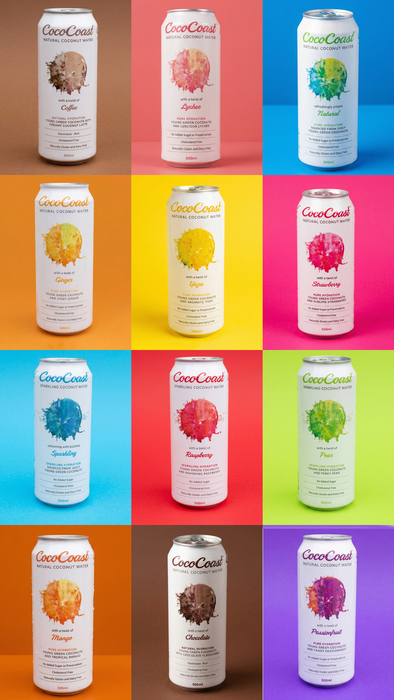
CocoCoast produces a 17-strong portfolio spanning pure, flavored and sparkling coconut waters, including mango, lychee and raspberry variants.
Russell says the breadth of the range has helped the company appeal beyond traditional coconut water consumers.
“There is a group of consumers interested in hydration and the functional attributes of coconut water who simply don’t like the taste of traditional coconut water.
“Our approach has been to give those consumers other entry points into the category rather than assuming everyone wants the same product.
“Function can generate initial interest, but taste and repeat purchase are what ultimately build a sustainable beverage brand,” he says.
The US expansion is part of CocoCoast’s wider push into international markets.
Industry research values the global coconut water market at around US$5.1 billion in 2025 and forecasts it will reach US$19.3 billion by 2033, equivalent to average annual growth of approximately 18.2%.¹
CocoCoast’s 53% growth over the past year compares with forecast global category growth of around 18%.
Russell says the size of the markets the company is entering gives it room to grow well beyond its current scale.
“Our five-year ambition is a substantial increase from where we are today, but the biggest opportunities available to us now are in markets many times larger than Australia.
“We have spent more than a decade proving the model here. The next stage is about taking that model offshore and building much greater scale,” he says.
Russell says the company will focus on building strong sales in each market rather than simply entering as many countries as possible.
“We will measure success by repeat purchase, rate of sale and profitable market depth. The aim is to build sustainable markets rather than simply add more flags to the map,” he says.
CocoCoast says its current production volumes give it capacity to supply a much larger US business.
The company has also secured Non-UPF certification across its full 11-product portfolio, which it says makes it the first coconut water range globally to achieve the certification.
Visit CocoCoast
Tagged companies: